
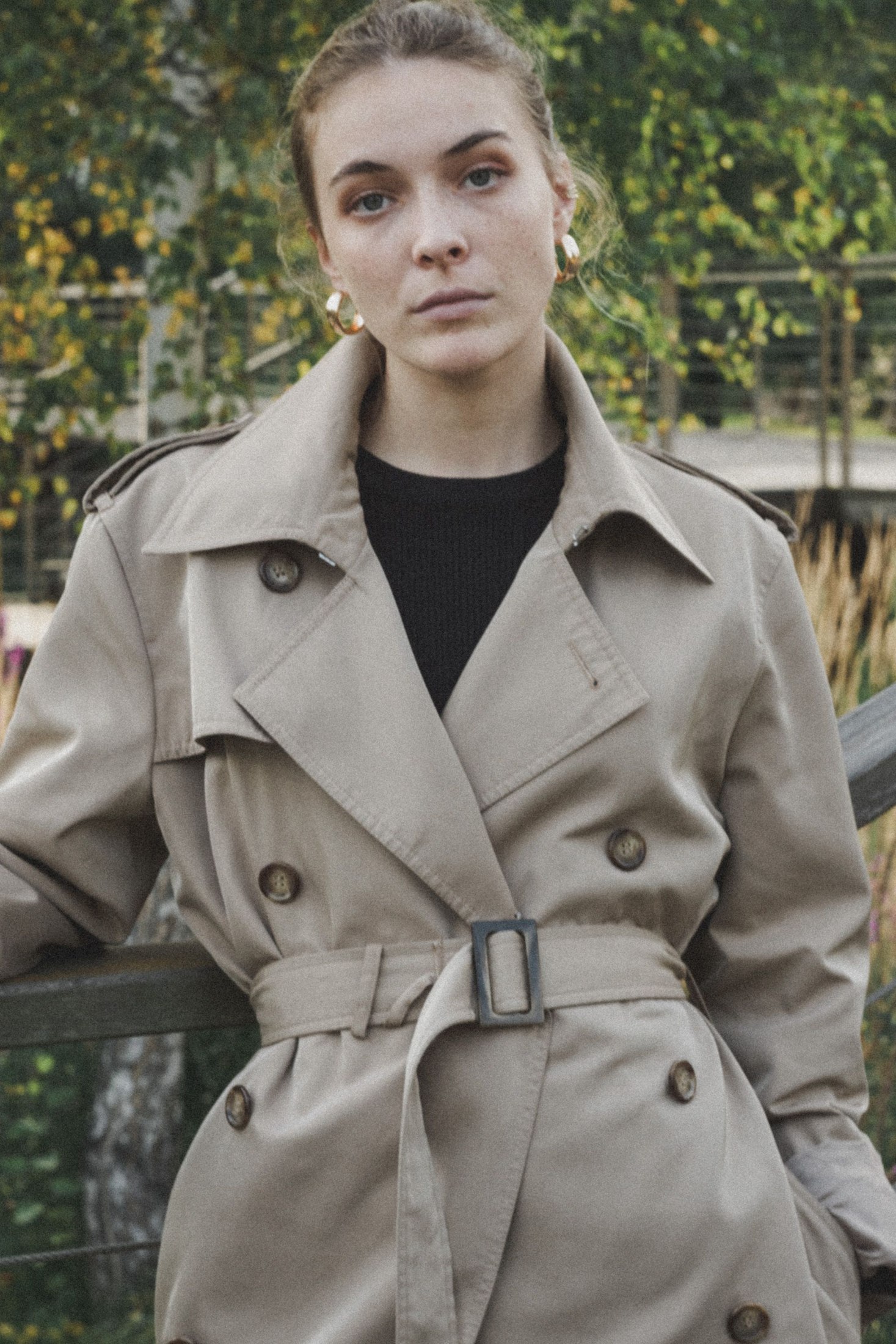
A trench coat changes an outfit even when worn open. Its length creates a large outer shape, its lapels frame the upper body, and its belt adds a horizontal line. Choosing those proportions is less about finding a universally flattering length and more about seeing how the coat works with your skirts, trousers, and preferred shoes. Start with a complete outfit underneath, then judge the trench as part of it.

Use your clothing hems as reference points
Put on an outfit you wear often and compare where the coat finishes. A hip-length trench shows most of the trousers or skirt beneath it. A knee-length version covers more of the outfit while leaving a substantial lower section visible. A mid-calf trench creates a longer outer column and makes the shoes a more prominent finishing detail.
With skirts, notice the gap between the two hems. A narrow accidental-looking strip may bother you more than a clearly visible length of skirt. There is no rule requiring a coat to cover every dress. Try a knee-length trench over a longer straight skirt and a long trench over the same skirt. Compare the shapes without automatically assuming that more coverage produces a better result.
Read volume from the side, not only the front
A trench can look neat from the front while collecting a large amount of fabric behind the belt. Turn sideways and check how the back yoke, pleats, and skirt portion fall. If the coat has a generous cut, tightening it dramatically may turn the back into a bundle. A looser fastening can preserve its intended shape more successfully.
Try the coat over the thickest layer you expect to wear beneath it. Sleeves should allow comfortable elbow movement, and the upper back should not pull when you reach forward. A coat that fits only over a thin T-shirt may not work for your regular knitwear. Choosing sufficient room is more useful than trying to create a particular waist measurement with the belt.
Place the belt where the coat allows
Belt loops and the coat’s shaping offer a starting position. Fasten the belt there first before experimenting with a different height. Moving it substantially above or below the loops can pull the side seams, interfere with pockets, or make the coat ride up. If the built-in position never feels comfortable, that particular coat may not suit your preferred way of wearing it.
Check how much upper-body fabric blouses above the belt. A little ease helps movement; a large fold may mean the belt is too tight or too high for the garment. On a knee-length stone trench, a relaxed fastening over navy trousers can define the center without turning the coat into a sharply cinched dress. Let the cloth settle before making further adjustments.
Choose a buckle or knot with manageable scale
A buckled belt creates a relatively clear horizontal band, while a knot adds local volume and loose ends. Either can work, but inspect where the bulk lands. A large center knot directly over the coat buttons can feel crowded. A modest off-center tie may spread the details more comfortably, provided it does not obstruct a pocket opening.
Follow the belt’s construction rather than forcing a complicated knot into thick material. If the belt is short, a simple buckle arrangement may look cleaner and stay more secure. If it is long, check where the ends fall when tied. They should not swing into your hands, trail below the hem, or require constant repositioning. Keep the fastening easy enough to undo when you sit.
Wear the trench open without losing its belt
An open trench shows the outfit underneath and creates two long front edges. Its belt still needs somewhere to go. Use the coat’s keepers, fasten it loosely behind if that arrangement sits comfortably, or remove it when the design allows. Avoid loose ends hanging at unrelated heights if they distract from an otherwise simple outfit.
Check whether fastening the belt behind changes the coat’s front drape. Pulling it too tight can drag the side seams backward and make the lapels flare. The goal is to manage the belt, not reshape the entire coat from the back. With a long trench over straight trousers, a clear open center can look composed without any visible waist definition at all.
Compare three complete proportions
Try a shorter trench with full-length straight trousers and loafers. Because much of the trouser leg remains visible, the outfit has a clear lower line even if the coat is relatively broad. Keep the inner top simple so the shorter coat does not compete with several extra hems. This is a practical option when you prefer less fabric around your legs.
Next, try a knee-length trench over cropped trousers and ankle boots, checking the gap above the boots. Finally, compare a mid-calf trench over a midi skirt and closed-toe flats. Separate the skirt and coat hems enough to make their relationship intentional. These are proportion experiments, not required formulas; choose the one that works with your wardrobe and normal stride.
Make the final decision while moving
Walk, use the pockets, climb a few steps if available, and sit down. Notice whether the coat hem brushes your shoes, the belt knot presses into you, or the front pulls across your knees. Recheck the side view after moving because the coat may settle differently from its carefully arranged mirror position.
Keep the length that works with your most-used outfits and the belt arrangement you can fasten without a performance. A trench does not have to be tightly belted to look deliberate, and a long version is not automatically more polished than a shorter one. The successful proportion is the one that gives the underlying clothes a clear frame while remaining comfortable throughout an ordinary day.