
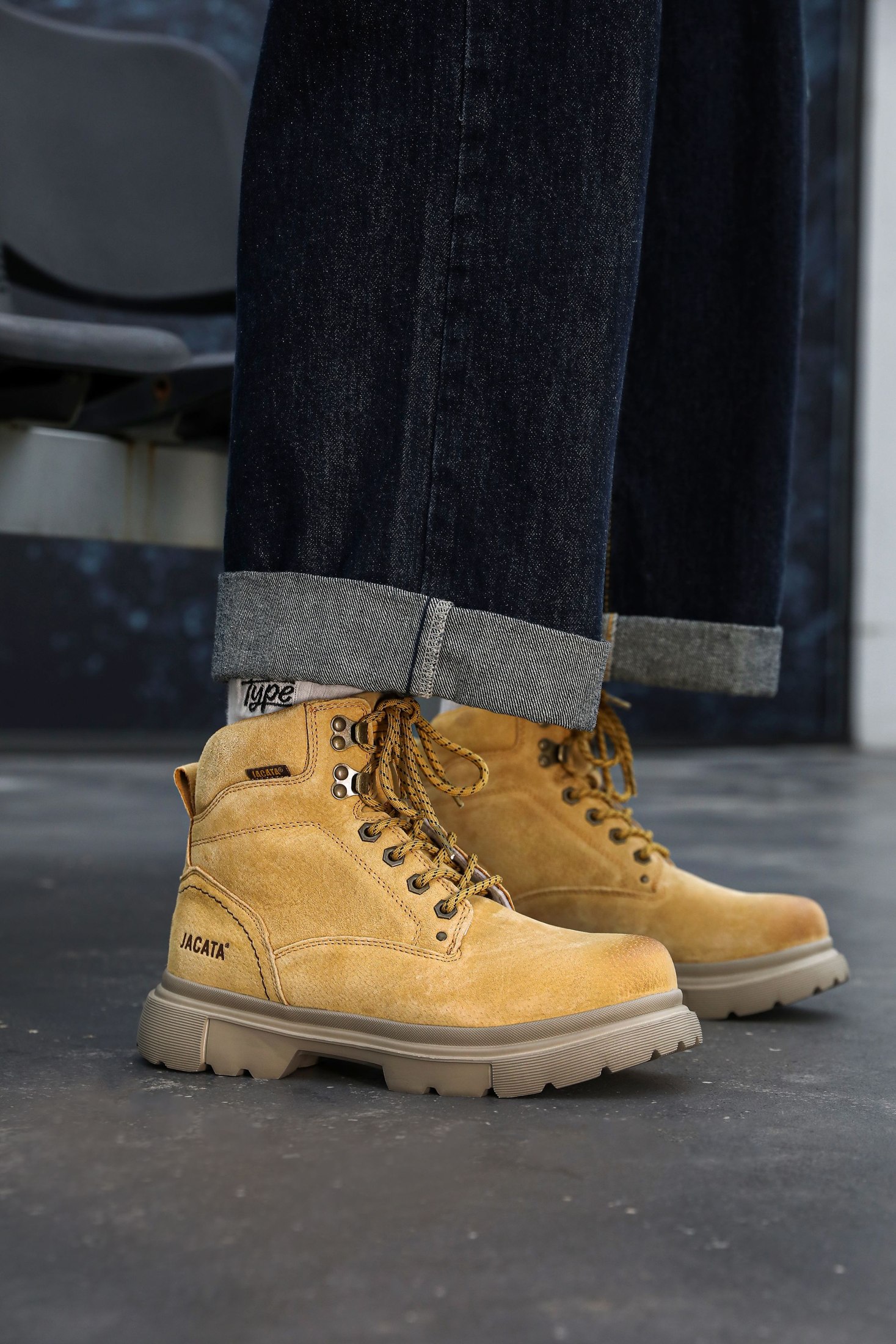
Straight-leg jeans and ankle boots can look uncomplicated until the denim catches on the boot shaft. Then a perfectly good pair of jeans develops a shelf at the ankle, or a cropped hem reveals more sock than intended. The solution is usually in the meeting point between the two garments, not in replacing the whole outfit. Start with the boots you actually plan to wear, then decide whether the jeans should overlap them or stop clearly above them.

1. Check what straight-leg means on your pair
A straight leg describes the general line of the jeans, but it does not guarantee a particular opening. Two pairs labeled straight can behave differently over the same boot. One may skim the calf and fall freely around the shaft; another may fit closely enough to lodge on its upper edge. Put the jeans on and smooth the lower leg once. If the hem immediately climbs back up, look at the opening before blaming the length.
Check the side view as well. A seam that twists forward or fabric that clings tightly behind the knee can make the bottom appear uneven. Choose a comfortable fit through the thigh so the denim can hang rather than being pulled upward by tension elsewhere.
2. Choose overlap or separation deliberately
For an uninterrupted line, let the jeans fall outside the boot shaft. The opening needs enough space to move around the boot without outlining its rim. A close-fitting shaft is useful here because it takes up less room beneath the denim. You do not need to hide the whole boot: the toe and part of the upper can remain visible while the ankle stays covered.
For a cropped look, leave a distinct gap above the boot instead of allowing the two edges to touch and catch. The exact gap is a preference, not a body rule. Try a small amount of visible sock first. If the hem and shaft repeatedly collide while walking, increase the separation or switch to a taller shaft.
3. Find the length while standing naturally
Stand with your weight distributed normally, not with one hip lifted for the mirror. Look for a hem that does not collect in several folds over the instep. A little softness can suit relaxed denim, but stacked fabric changes a crisp straight leg into a slouchier shape. Neither is inherently wrong; the useful question is whether that shape matches the rest of the outfit.
Pin a potential alteration before committing. Try both legs because posture and existing hems may differ. Walk across the room, sit, and stand again. If you wear two boot heights regularly, assess both. A hem chosen solely around a heeled pair may drag when transferred to flat ankle boots with a shallower upper.
4. Use a cuff only when it improves the join
A single cuff can lift a hem out of the boot opening and introduce an intentional horizontal edge. Start narrow enough that it does not become the dominant feature of the lower leg. Keep the fold even around the back, where excess denim can create an accidental wedge. Cuff both legs to the same visible height rather than measuring only the amount folded inside.
Multiple thick rolls are less helpful when the jeans already feel bulky. They can press against a wide shaft and undo the clean separation you wanted. If the cuff keeps unfolding or requires repeated adjustment, a different inseam may be more useful. Do not force a cuff onto a stiff hem simply because the outfit needs shortening.
5. Let socks participate in the outfit
When socks show, treat them as an intentional color panel. Charcoal socks between black boots and indigo jeans create a quiet transition. Cream ribbed socks with tan boots make the ankle detail more noticeable. A vivid sock can work too, but it becomes another focal point and may compete with a patterned top or conspicuous bag.
Check sock thickness inside the actual boots. A decorative pair that changes the fit of the footwear is not a successful styling solution. Sit down and cross one ankle over the other: this reveals how much sock becomes visible during normal movement. If you dislike that amount, a taller boot shaft may solve the issue more comfortably than continually pulling the jeans down.
6. Build two outfits around different boot shapes
For a polished everyday combination, try dark straight jeans, fitted black ankle boots, a gray crewneck, and a short black jacket. Let the denim overlap the shafts and keep the top near the waistband so the lower half remains easy to read. A simple black belt repeats the boots without introducing another strong color break.
For a softer weekend version, combine medium-blue jeans, brown rounded-toe boots, an oatmeal sweater, and an olive utility jacket. A single cuff can work if it leaves a clean gap. The rounded toe and relaxed jacket make a little denim texture feel appropriate. Avoid adding a long dangling scarf directly over a very bulky sweater if the outfit already feels crowded.
7. Finish with a moving-hem check
Before leaving, take several normal steps and look again without rearranging anything. The best pairing is the one that settles back into place by itself. Check that the rear hems stay off the floor, the boot tops do not print through the denim, and neither cuff catches on a pull tab or zipper.
If the ankle still looks congested, change one variable at a time: uncuff the jeans, try a narrower shaft, or test a slightly shorter hem. Do not simultaneously replace the top, belt, and jacket; that makes the actual cause harder to identify. Once you find a reliable pairing, keep those jeans and boots mentally linked as an outfit foundation. The goal is a hem you can forget about after getting dressed.