
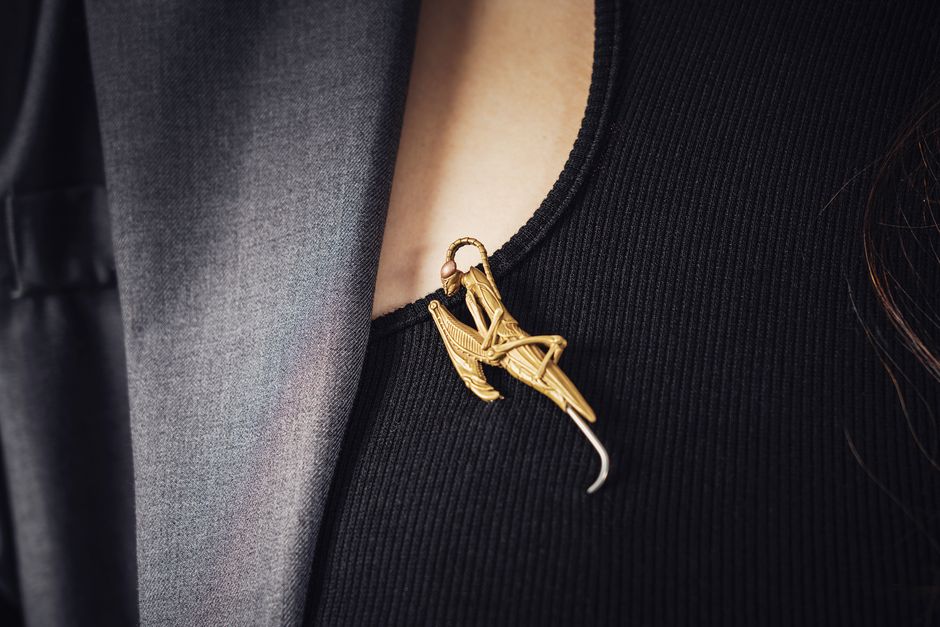
A plain party dress gives a brooch room to make an impression. Move the same piece from your upper chest to your waist and the dress can feel quite different. One placement draws attention toward your face; another makes a seam or fold the focal point. The best position depends on the fabric, the construction, and how you want the dress to look when you move. Before fastening anything, try a few positions in the mirror. A little experimenting can make a familiar dress feel thoughtfully dressed for the occasion.
Let the dress suggest a starting point
Put the dress on with the undergarments you plan to wear, then look at its strongest lines. A high neckline, a defined waist, or a gathered shoulder each offers a natural place to begin. Look for a spot where the brooch seems connected to the design, with enough plain fabric around it to show its shape.
Hold the brooch in place with its pin closed before making any holes. Look at the whole outfit from a few steps away, rather than judging only the close-up view. If the dress appears pulled to one side, or the brooch seems detached from every other detail, shift it slightly and compare.
Try the upper chest for an easy focal point
On a dress with a simple crew or jewel neckline, an off-center brooch on the upper chest is an easy starting point. Keep it below the neckline with a visible margin of fabric around it. This gives the decoration a clear setting and leaves the edge of the dress looking clean.
There is no compulsory side. Try both, especially if your hairstyle covers one shoulder or the dress has an asymmetric detail. Consider practical contact, too: a bag strap, seat belt, or the edge of your evening wrap may repeatedly catch a brooch in an otherwise attractive position.
Follow the shape of the brooch
A long leaf or spray can sit at a gentle diagonal, echoing the slope toward your shoulder. A rounded cluster often looks settled upright, while a geometric piece may suit a structured dress. Rotate the brooch in your hand before choosing its position, checking that the fastening will hold it in that orientation.
Work with the neckline
A neckline is a useful visual guide, but its edge is not always strong enough to support jewelry. A narrow binding, delicate scallop, or soft folded edge may buckle under a heavy piece. Place the brooch on stable fabric nearby when possible, and check that its weight does not turn the neckline outward.
V and scoop necklines
With a V-neck dress, try the brooch beside one sloping edge, leaving a little space between the jewelry and the opening. This keeps the V visible. On a scoop neck, a position above and to one side of the bust can feel balanced without making the decoration look as though it has slipped from the center.
Boat and asymmetric necklines
A boat neckline can suit a brooch near one shoulder, provided there is enough substantial fabric to support it. On a one-shoulder dress, the covered shoulder may offer a natural location. Check the construction carefully: pinning through soft draping can flatten a fold that gives the dress its character. Hold the piece there first and watch what happens to the silhouette.
Use the waist when the dress has structure
A brooch at the waist can emphasize an existing seam, a fabric belt, or the meeting point of gentle gathers. It works especially well when the dress already directs the eye there. Try an off-center position where a sash overlaps, rather than automatically placing the brooch directly over the middle of your body.
Keep the decoration clear of a zipper and away from an area that folds sharply when you sit. A brooch can highlight a secure wrap or sash, but it should not be responsible for keeping the dress closed. If the fastening is under tension, address the fit or closure separately before adding jewelry.
On a loose shift dress with no waist seam, a heavy brooch at waist level may create a hanging point. Move it higher if the fabric starts to sag. You do not need to invent a waist detail for the accessory to earn its place.
Match the weight to the fabric
The back of the brooch matters as much as the front. Check for a straight pin, a clasp that closes securely, and rough edges that might snag. A broad decorative face does not necessarily distribute weight evenly; the pin position also affects how the piece sits.
- Firm woven fabrics: These may support a substantial brooch, but still need checking for pulling around the pin.
- Soft jersey: Choose a light piece and watch for stretching or diagonal drag lines.
- Satin and fine silk: Pinholes and snags can be conspicuous. Avoid piercing the fabric if you cannot accept a possible permanent mark.
- Lace or sheer overlays: Do not rely on a delicate surface layer to carry the weight.
A small piece of suitable backing fabric behind a stable area can sometimes help distribute the load, but it cannot make a fragile dress safe to pierce. Avoid improvised adhesive solutions that could leave residue. If the dress is precious or the fabric seems vulnerable, ask a dressmaker about attachment options before pinning it.
Give the brooch breathing room
Once you choose a position, add your other accessories and look again. A brooch near the neckline already provides decoration in that area, so a necklace may feel unnecessary. If you enjoy wearing both, leave a clear gap so the chain cannot brush against the pin or become tangled in raised settings.
Consider the mood of the dress as well. A sparkling cluster can give a matte dress an evening focus. A sculptural metal brooch may bring definition to a simple shape. Your accessories need not match exactly; the useful question is whether your eye settles comfortably on the detail you intended to feature.
Check the placement in motion
Fasten the brooch while the dress is off your body whenever practical, keeping the sharp point away from your skin and checking the clasp. Put the dress back on, then sit, raise your arms, and reach forward. Notice whether the piece tilts, presses against you, or pulls the fabric out of line.
Try your outer layer over it and remove that layer once. If anything catches, adjust the placement before heading out. The right spot should look good through an ordinary evening of greeting people, sitting down, and moving around. When the fabric hangs smoothly and the brooch stays comfortably in place, your plain dress has the finishing detail it needs.