
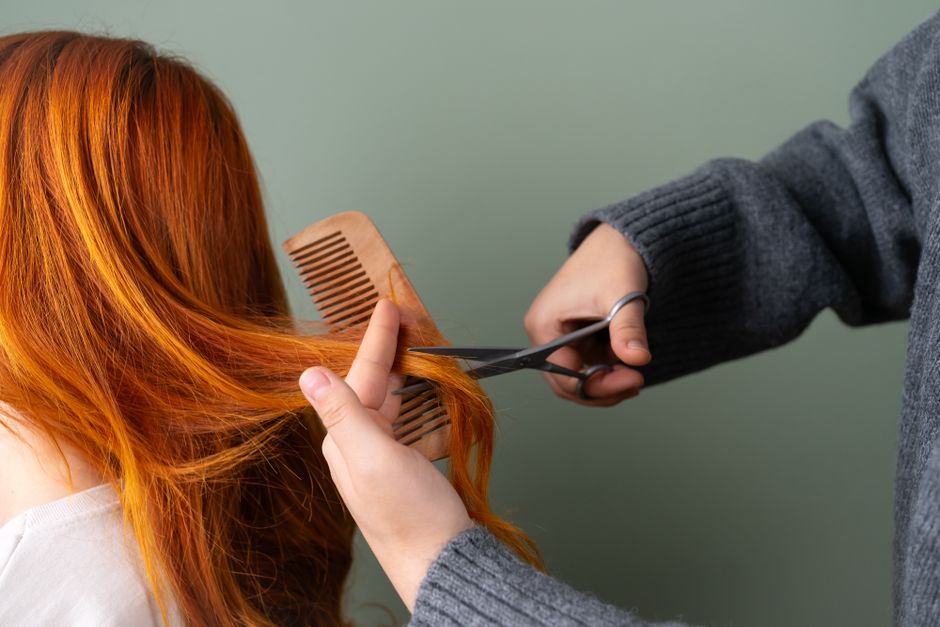
A blunt bob has a lovely sense of purpose: the ends form a clear line, and the whole shape feels considered. Sometimes, though, you want that line to look a little less solid. Softening the Look of a Blunt Bob With Texture is about introducing small spaces and gentle movement while keeping the outline you enjoy. You do not need a head of curls, a heavily layered cut, or a shelf full of styling products. A few well-placed separations can make the same bob feel more relaxed.
Decide where you want the softness
Look at your bob when it is dry and sitting naturally. Is the lower edge forming a dense shelf? Do the sides sit like two flat panels? Or does the hair around your cheeks feel more rigid than the rest? Identifying one area gives you a useful starting point. Adding texture everywhere can make a simple haircut harder to manage without addressing what actually bothers you.
For this purpose, texture means visible variation: a few strands sitting apart, sections overlapping loosely, or a slight change in direction through the middle lengths. It does not have to mean roughness. The aim is a bob that still has a recognizable edge, with enough movement above it to feel easy.
Keep the perimeter, discuss the interior
If your bob feels bulky even after gentle styling, a conversation with your hairdresser may help more than another product. Explain that you like the blunt outline but want less solidity within the shape. Ask whether a small amount of internal shaping would suit your hair’s density, natural movement, and usual routine.
There is no single cutting technique that works for every bob. Fine hair may need its weight preserved so the ends continue to look full. Dense hair may benefit from carefully placed weight removal, while curly hair needs consideration of how the shape contracts as it dries. Excessive thinning can leave some textures looking wispy or harder to settle.
- Show where the bob feels too heavy when you wear it normally.
- Say whether you usually style with heat or let your hair dry naturally.
- Ask how any proposed shaping will affect the fullness of the ends.
- Bring a reference showing subtle separation rather than a completely different haircut.
Avoid trying to soften the edge yourself with household scissors or thinning shears. Small cutting changes can alter a short haircut noticeably, especially around the face and nape.
Prepare for movement without coating the hair
Start with your usual gentle wash and conditioning routine. Concentrate conditioner where your hair needs it, then rinse thoroughly according to its instructions. A blunt bob can look unexpectedly solid when the lengths are weighed down by residue, but skipping needed conditioning can leave the surface rough and difficult to arrange.
Press out excess water with a towel rather than rubbing vigorously. Detangle gently with a tool suited to your hair, working through the ends before moving upward. If you use a leave-in styler, begin with less than you think you need. You can add a little later; removing an overly generous application usually takes more effort.
Choose a finish you actually like touching
A light styling lotion may suit hair that needs a little control, while a small amount of flexible cream can help separate dry, coarse ends. A dry texturizing spray may provide separation on smoother hair, but it can also feel gritty or drying. Choose by the finish and label directions rather than assuming that every bob needs the same formula.
Patch test unfamiliar products as directed, and stop using anything that causes irritation. Keep styling products away from your eyes and avoid applying them to an irritated scalp. Persistent itching, flaking, or other scalp problems deserve advice from a dermatologist.
Create separation as the bob dries
For hair with a little natural bend, gently gather a few broad sections in your hands while damp, then release them. Allow those sections to settle without repeatedly combing through them. You are encouraging slight irregularity through the lengths, rather than trying to force a curl pattern your hair does not have.
If you blow-dry, use a comfortable heat setting and keep the dryer moving at a safe distance. Guide the hair with your fingers instead of pulling every section into an identical smooth panel. Follow your natural growth direction near the scalp, then let a few sections through the sides lie at slightly different angles. Avoid directing hot air at your face or holding it against one spot.
Leave the final judgment until your hair is completely dry. Damp pieces often appear more separated than they will once dry, and adding extra product too soon can create a heavy finish. Once everything has settled, use your fingertips to loosen only the areas that still look too uniform.
Use a tiny amount of finishing product precisely
Rub a small dab of your chosen finishing cream between your hands until it spreads thinly. With what remains on your fingertips, touch a few sections through the outer lengths. Lightly separate them, then let go. Avoid smoothing both palms over the entire bob, which can press the hair back into one continuous sheet.
Work above the bottom edge as well as at the tips. If all the product lands on the very ends, the perimeter may turn into heavy points while the rest stays flat. A little separation through the middle gives the eye something softer to follow without breaking up every strand.
Adjust for your hair’s density
On fine hair, start with just a few surface sections and keep the underside relatively undisturbed. This helps preserve the impression of fullness. On thicker hair, work with a few sections beneath the surface before adjusting the outer layer. For curls and coils, retain the natural groupings that give the shape definition; pulling them apart repeatedly can create more expansion than you intended.
Check the shape before adding more
Step back from the mirror and look at the whole silhouette. Texture that seems barely visible up close may be enough at normal conversational distance. Check both sides and, with a second mirror if available, the back. Stop when the lower line still reads clearly but the hair above it no longer looks completely uniform.
If the bob looks stringy, separate fewer sections next time and use less finishing product. If it looks fluffy, stop handling it and gently settle the outer surface with lightly coated fingertips. If the ends remain stubbornly bulky, save that observation for your next haircut instead of piling on more styling layers.
The most useful result is one you can repeat on an ordinary morning. Keep the parts that work with your hair and leave the rest. A blunt bob can retain its clean shape while gaining a little looseness, and that small adjustment may be all the softness you wanted.