
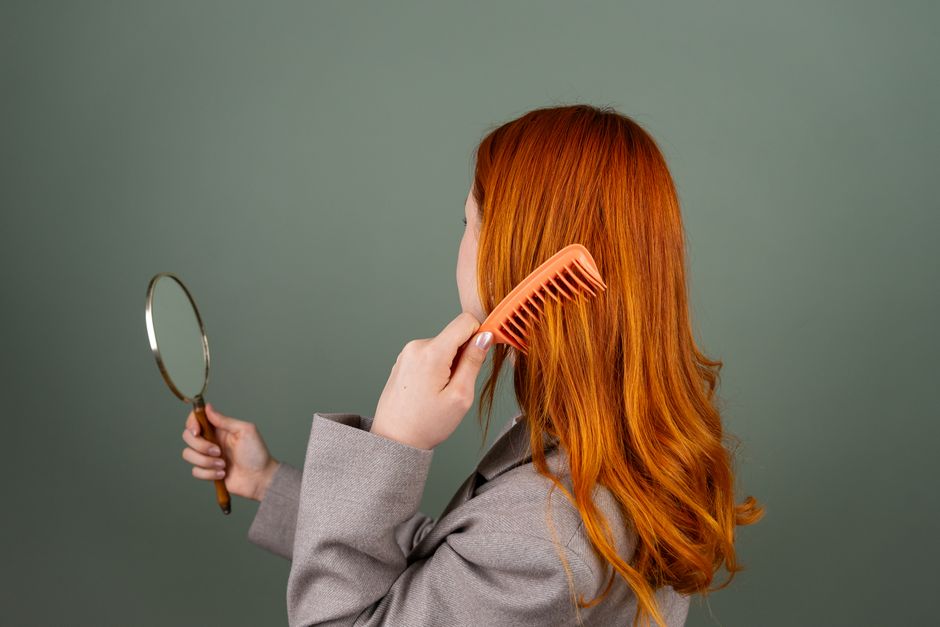
A hair part can look perfectly straight while you hold the comb, then spring apart as soon as you let go. If a cowlick is involved, that little rebellion is useful information. Your roots are showing you where they naturally want to go. Choosing a Hair Part That Works With a Cowlick starts with noticing that direction, then finding a line that gives your hair room to settle. The aim is a part you can live with on an ordinary morning, without repeatedly flattening the same stubborn section.
Find the cowlick before choosing your line
A cowlick is a section of hair that grows in a different direction from the hair around it, sometimes forming a swirl. It may sit near your forehead, at the crown, or beside your usual part. Its position matters: a front cowlick can lift or divide the hair around your face, while a crown swirl can make the back of a straight part split unexpectedly.
Look at your roots when your hair is clean and free of heavy styling products. Gently loosen your usual part with your fingertips and let the hair fall. Check the front in a mirror, then use a second mirror to see the crown. Notice where the roots turn, rise, or separate without help. You are looking for a recurring pattern, rather than a temporary bend left by sleeping.
Let the front and back have different answers
Your part does not need to run in one unbroken line from your forehead to your crown. That expectation can create unnecessary work when the front of your hair falls comfortably one way and the back swirls another. A part can begin slightly off center, travel back a short distance, and disappear into the natural movement at your crown.
Choose the front position for how the hair falls around your face; choose the ending for how the crown settles. If extending the line exposes a split at the back, stop it earlier. Use your fingers to ease the remaining hair into its natural direction. Check the result from behind before deciding that the front position is wrong.
Compare three realistic part positions
Start with small changes around your existing part. Moving it a little can be enough to keep a cowlick from sitting directly on the dividing line. Test each option with the same basic styling routine so you can tell whether the placement itself makes a difference.
A slightly off-center part
This is a useful starting point if you like a balanced shape but a precise middle part keeps opening at the front. Shift the line just to one side of the stubborn roots. Let the lifted section belong fully to one side, instead of trying to divide it evenly. The result may feel familiar while requiring less adjustment.
A shallow side part
A modest side part may let a front cowlick become a natural sweep. Try both sides: the side you prefer visually may behave differently from the one that follows your root direction. Watch whether the front section curves comfortably or stands up in a ridge. A deeper part is not automatically better; moving too much hair across can create another awkward bend.
A softened middle part
If you enjoy a middle part, try a less exact line before abandoning it. Separate the hair loosely with your fingers and allow a small deviation around the cowlick. Keep the overall impression centered without insisting that every root obey the comb. This works best when the hair already falls reasonably close to the middle.
Judge the part after you release it
Holding hair down can make almost any placement look promising. The useful test comes when your hands are away. After styling, let the roots cool and settle, move your head, and tuck and untuck your hair as you normally would. Look for a part that returns to a comfortable shape without constant correction.
- At the forehead: Does the front sweep naturally, or does it spring into a gap?
- Along the line: Does one small section repeatedly cross over?
- At the crown: Does the part end smoothly, or continue into an unwanted split?
- During movement: Can you look down and turn your head without needing to reset everything?
Try a promising position on more than one wash day before making a haircut decision around it. A single result can be influenced by how you slept, how the roots dried, or how much product was left in the hair.
Set the direction gently while roots are damp
For straight or loosely wavy hair, damp roots are often easier to arrange than roots that have already dried into a strong bend. If you are adjusting dry hair, lightly dampen the affected section down to the roots. Drenching the lengths while leaving the root bend untouched is unlikely to help the part settle.
Place the part, then guide the roots with your fingers or a brush suited to your hair. If you blow-dry, use a comfortable low heat and gentle airflow, keeping the dryer moving and away from your scalp. Avoid pulling hard to force the hair flat. Let the section cool before releasing it. Repeatedly applying more heat is a poor trade for a perfectly straight line.
With curly or tightly coiled hair, choose the part while the hair is wet or damp and before setting your usual curl pattern. Avoid repeatedly combing through dry curls to redraw it. A slightly curved division that respects curl groupings may be easier to maintain than a sharp line through the middle of them.
Match the placement to your cut and daily effort
A cowlick near a fringe deserves attention before scissors come out. Ask your stylist to see how the front roots behave with little styling, and explain how much time you want to spend arranging them. A fringe that looks lovely when carefully held in place may separate during your normal day. Length, weight, and the cowlick’s position all affect the options.
The same conversation helps with short layers around the crown. Shortening a section may reveal more of its natural lift, while extra length does not guarantee that it will lie flat. If your hair’s texture or fullness has changed, reassess your part with the hair you have now. There is no required part for any age.
Keep the finish flexible
Once the placement works, use only as much styling product as you need. Follow the label, patch test unfamiliar products as directed, and stop using anything that irritates your scalp. A cowlick is a growth pattern, but a newly widening part, sudden shedding, or persistent scalp discomfort deserves a dermatologist’s advice.
Your most useful part may include a little lift at the front or a gentle turn near the crown. Let those details guide the shape. When the line stays comfortable through everyday movement and needs only a quick adjustment, you have found a placement that works with your hair.