
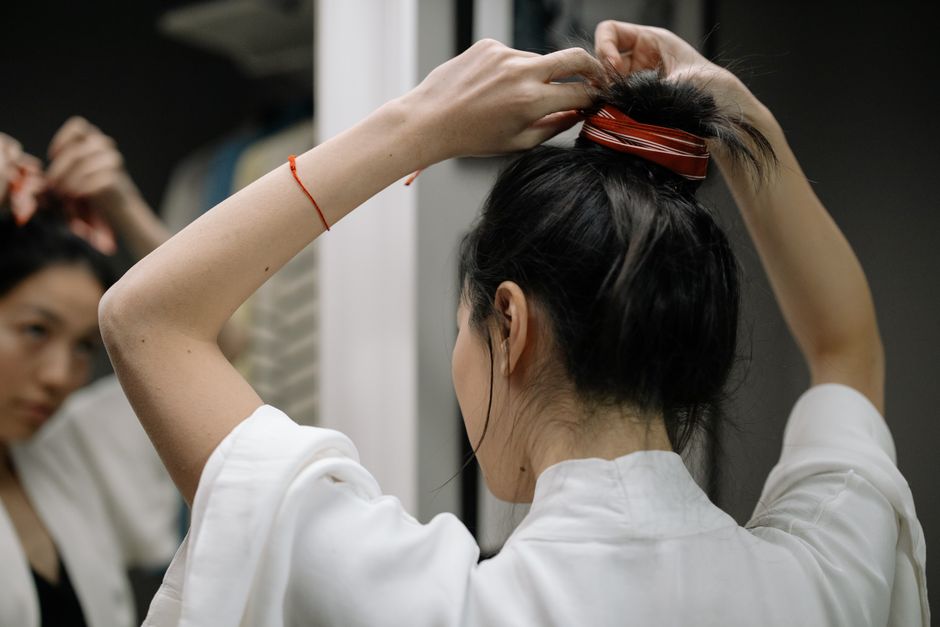
A low bun can look beautifully composed when you leave the house, then loosen at the nape before you reach your destination. Humid weather adds another complication: the surface may puff up while the bun starts to slide. Keeping it comfortable and secure takes preparation, a supported base, and a finish that allows some natural texture. You do not need to pull your hair painfully tight or coat it until it feels rigid. The aim is a bun that stays balanced even when the air feels damp.
Work out what is coming loose
Before changing your routine, notice where the style fails. If the ponytail drops, the elastic or its placement needs attention. If the ponytail stays secure but the coil unravels, the pins are not catching enough anchored hair. If only the surface grows fuzzy, the structure may be sound. That calls for a small finishing adjustment rather than a tighter bun.
Humidity can encourage hair to take on moisture and change shape, especially when you have brushed or stretched it away from its natural pattern. Sweat around the nape can also leave the area damp. A softly textured bun is often easier to maintain than a perfectly flat finish, because a little expansion does not immediately make it look unfinished.
Prepare your hair without making it slippery
Start with hair that is dry at the roots and nape. Twisting damp hair into a tight coil can leave the center wet and make the finished shape less predictable as it dries. If you wash before styling, give yourself enough drying time. Use gentle airflow if needed, and avoid repeatedly applying high heat to get every strand absolutely straight.
Keep conditioner mainly where your hair needs it, often through the lengths and ends, and rinse according to its directions. Heavy residue near the roots can make a secured style feel slippery. Equally, skipping all conditioning may leave dry ends harder to tuck away. Aim for manageable hair rather than hair stripped of softness.
If you use a styling product, choose one suitable for your texture and follow its label. A small amount of smoothing cream can help dry lengths lie together; a light holding product may suit hair that loses shape easily. Introduce new products with a patch test according to their directions, and stop using anything that causes irritation. Adding several layers rarely fixes an unstable base.
Place the base where your head can move freely
A low bun needs room above your collar. Gather your hair at the back of your head, just above the nape rather than directly in the neck crease. Turn your head and look down before fastening it. If the gathered hair pulls when you move, raise the position slightly or release some tension around the hairline.
Choose a covered elastic that grips without snagging. It should hold the ponytail securely with comfortable tension. An overstretched tie encourages slipping; a very tight one can leave your scalp sore. If your hair feels tender, restart more loosely. Pain is a reason to adjust the style, not something to wait out.
Keep the weight close to the base
A compact bun generally has less room to swing than one that projects far from your head. For long or heavy hair, spread the coil around the elastic instead of stacking it outward. You want the secured ponytail to support the weight, with pins holding the shape around it. Check that your collar does not push against the underside of the bun when you sit down.
Build a bun with separate points of support
Have your elastic and several smooth, undamaged hairpins within reach before you begin. Trying to hold a half-finished bun while searching a drawer usually means losing the tension you just established. Use a mirror to check the back if you can, particularly while learning where your pins hold best.
- Secure the ponytail. Gather the hair gently, smooth it with your hands or a suitable brush, and fasten the elastic. Check that the base stays put when you turn your head.
- Guide the length into a coil. Twist only enough to bring the hair together, then wrap it around the base. Leave some flexibility instead of winding until the hair feels like a hard rope.
- Tuck the ends underneath. Keep them close to the elastic, where they can be caught by a pin. Ends left on the outer edge are more likely to escape as the surface expands.
- Anchor around the bun. Catch a small section of the coil with a pin, then guide the pin into hair near the secured base. Repeat at different points so one pin is not carrying the whole shape.
- Check movement and comfort. Turn, nod, and gently shake your head. Reposition any pin that pokes or any section that shifts, rather than adding pins without checking what they catch.
For very thick hair, dividing the ponytail into two sections and wrapping each around the base can make the shape easier to control. Pin the first section before wrapping the second. For naturally curly or coily hair, preserve the texture with gentle handling and avoid repeatedly brushing the surface in pursuit of a glassy finish.
Finish for damp air, with a little flexibility
Once the structure feels secure, address the surface. Smooth a small amount of an appropriate finishing product over your palms first, then lightly pass them over the areas that need it. Keep rich products away from the elastic if they make your hair slide. There is no need to flatten every short hair around your face.
If you use hairspray, follow the application distance and other precautions on the label, avoid your eyes, and use it in a ventilated area. A product labeled for humidity resistance may help the finish, but it cannot guarantee that hair will ignore damp weather. Let the application settle before touching the bun again.
Choose face-framing pieces deliberately. A few soft strands can make the style feel relaxed, but very short pieces may curl or lift in moisture. Let them follow their natural direction rather than repeatedly wetting and stretching them flat.
Make small repairs when the weather changes
Carry a spare elastic and a few pins in a small pouch. If the bun loosens, first check the ponytail base. When that still holds, tuck the escaped section back into the coil and secure it near the base. If the elastic has slipped, rebuilding the bun is usually more useful than pushing extra pins into a sagging shape.
After a warm walk, gently blot moisture at your neck without rubbing the hair. Avoid adding water to smooth the bun, since that may encourage more shape changes. A little surface softness is compatible with a polished style. At home, remove pins individually and unwind the bun gently. Give your scalp a break from tension, and see a dermatologist for persistent scalp discomfort, irritation, or unusual hair loss. A successful low bun should feel as easy to wear as it looks.