
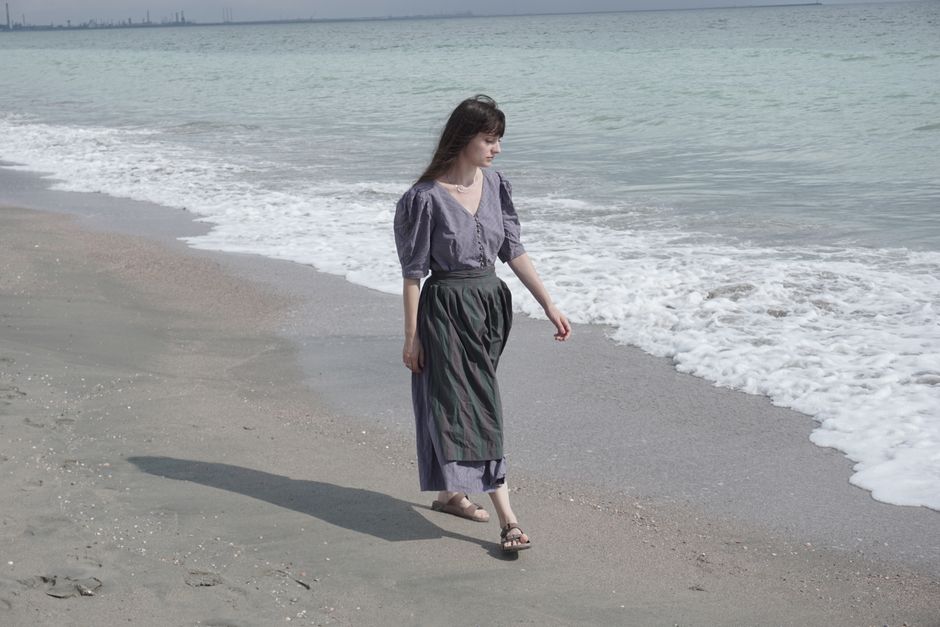
A poplin skirt can give you a lovely combination of crispness and ease: a little movement, a clean outline, and enough structure to feel dressed. The challenge is that the same fabric can stand away from your body where gathers, pockets, and a waistband meet. If yours feels puffier around the middle than you expected, look at how the skirt is built before changing everything else. Wearing a poplin skirt without adding bulk at the waist starts with giving its fabric somewhere to fall.
Let the construction do the work
Poplin describes a weave rather than one particular fiber. Depending on its composition and finish, it can feel soft and light or quite firm. That difference matters at the waist: a crisp fabric tends to hold gathers outward, while a softer one may settle closer to the body. Both have their appeal, but they create different silhouettes.
When you examine a skirt, look below the waistband as well as at it. A smooth band cannot prevent fullness if a generous amount of stiff fabric is gathered directly underneath. For a quieter outline, seek a flat front, shaped panels, or pleats that stay closed through the upper hip before opening farther down.
Notice where the fullness begins
An A-line skirt with shaped seams can offer room at the hem without concentrating extra fabric at the waist. A gathered skirt gives a different effect, especially when its gathers are dense. If you love that airy shape, choose it deliberately and keep the layers above it simple. Fullness can be beautiful; the aim is to avoid extra bunching that makes the outfit feel awkward.
A deep yoke can also help because it moves the gathering point lower. Check where that seam lands on you, though. It should lie comfortably instead of forming a tight horizontal ridge. The useful question is whether the skirt falls freely from its seams, rather than whether its label promises a particular fit.
Find a waistband that rests comfortably
A waistband that digs in can make the fabric immediately above and below it bunch. A loose waistband can shift, tilt, or collect fabric at one side. Try positioning the skirt where it naturally rests, then sit down and take a full, comfortable breath. You should not need to brace your middle to keep the band looking smooth.
Your most comfortable position may be near your natural waist or slightly below it. There is no requirement to wear a skirt higher simply because that is how it appears in a photograph. If moving it lower makes the upper skirt pull across your hips, the cut may not suit that placement.
- Fixed waistband: Check that it lies level and closes without pulling the fabric toward the fastening.
- Elastic waistband: Look for even gathers and enough ease that the elastic does not fold or roll when you sit.
- Flat front with an elastic back: Inspect the side view, where the smooth section meets the gathered section.
If the hips fit well but the waist gaps, a tailor may be able to adjust the band. Ask how the alteration would affect pockets, pleats, or a side fastening before proceeding.
Check hidden sources of puffiness
Pocket bags can add surprising volume, particularly when they are caught in the waistband or made from firm fabric. Empty the pockets and let the skirt settle. If the sides still flare sharply, look inside to see whether the bags are folded, twisted, or sitting toward the front.
Useful pockets are worth keeping, so test them with your hands before dismissing the skirt. Their openings should return to a reasonably flat position afterward. Carrying your phone or keys in a bag can help preserve the intended line when loaded pockets drag or bulge.
Check the lining too. It should hang independently without being trapped in the waistband or caught around your hips. An additional slip may be useful for coverage, but another elastic band and another layer of fabric can create exactly the congestion you are trying to reduce. Choose only the underlayers you actually need.
Choose a top that meets the skirt cleanly
You do not need a tight top to balance a full poplin skirt. Look instead for a top with a manageable amount of fabric around its lower edge. A lightweight jersey tee, a smooth sleeveless shell, or a softly shaped woven top can make the meeting point easier to arrange.
For an untucked option, try a hem that finishes near the waistband and releases without gripping it. Raise your arms and sit down to check the coverage. A short top should feel comfortable in movement, especially if you prefer your middle covered throughout the day.
If you prefer a tucked top, choose one that leaves little excess fabric inside the skirt. Long tails, thick hems, and bulky side seams can show through a smooth upper panel. Spread any remaining fabric evenly and check the back. If you repeatedly have to rearrange it, a shorter or lighter top will usually be easier to wear.
Keep a second layer clear of the gathers
A light jacket worn open can sit comfortably over the outfit, provided its hem does not grip the skirt at its fullest point. Watch for a drawstring, elastic edge, or snug ribbed band that traps the poplin underneath. The layer should let the skirt move when you walk and fall back into place when you stop.
Use the skirt’s own details thoughtfully
A belt is optional. If the waistband already gives the outfit a finished edge, adding another band may simply crowd it. When a skirt has a fabric tie, flatten the tie before knotting it so you are not stacking twisted fabric over gathered fabric.
A large bow at the center front adds visible volume there. If the design allows it, try a smaller, loosely tied knot positioned slightly to one side. Avoid pulling the tie tight to force the skirt inward; that can create deeper bunches underneath. The fastening should secure the skirt comfortably.
Give crisp poplin a chance to settle
Follow the care label when washing and pressing. Crumpled fabric around a waistband can make the whole upper skirt look thicker, even when the fit is right. Smooth the band and arrange gathers gently as you press, using a temperature suitable for the fabric. Avoid pressing over elastic or trims unless the label permits it.
Before heading out, walk, sit, and stand again. Check whether the waistband stays comfortable, pockets settle, and your top remains where you want it. A little movement and fullness belong to a poplin skirt. Once the fabric can fall freely and the waist feels easy, you can enjoy that crisp, breezy shape without spending the day adjusting it.