
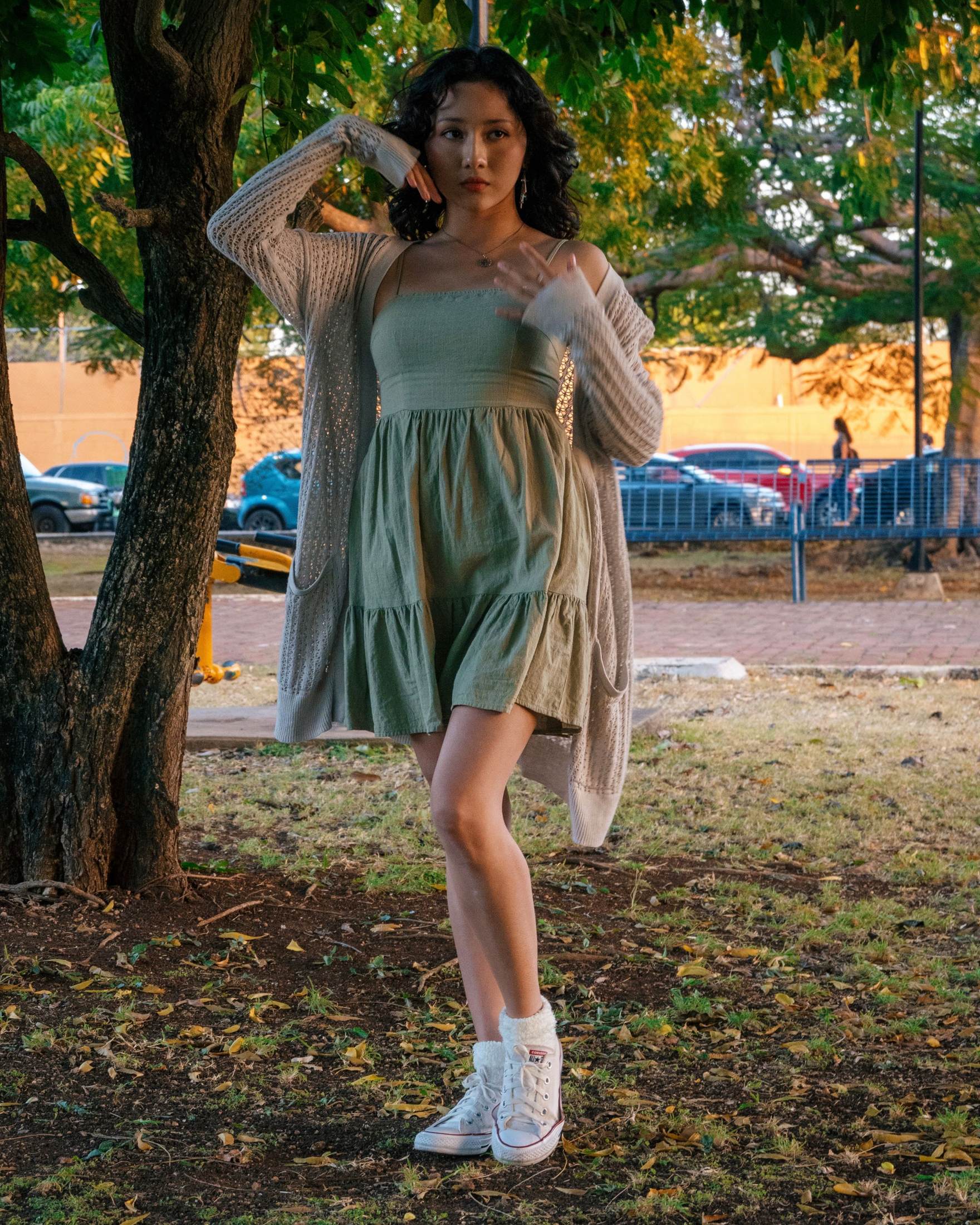
A cardigan can make a dress feel ready for an ordinary workday without giving it the formality of a jacket. The challenge is keeping the layers clear: a waist seam should not disappear under a heavy knit unless that is the silhouette you want, and dress sleeves should not bunch inside cardigan sleeves. Choose the combination as two garments sharing space, rather than treating the cardigan as a last-minute cover-up.

Read the dress before choosing the knit
Identify the dress’s main structural feature. A sheath depends on its relatively clean outline, a fit-and-flare dress emphasizes the waist, and a shirt dress already has a collar, buttons, and often a belt. Those details tell you where a cardigan can add warmth without obscuring the whole design. Lay the pieces together first to see whether their horizontal lines compete.
A gray cardigan ending near the waist can support the shape of a navy sheath. A longer open knit may create a softer column over a straight dress. With a full skirt, a heavy cardigan ending at the widest part of the skirt can look congested; try a shorter length or a finer fabric before deciding the dress itself is the problem.
Make room for the sleeves
Put on the dress and cardigan, then bend both elbows and reach forward as if using a keyboard. Watch for a tight ridge where the dress sleeve ends. Puff sleeves, rolled cuffs, and stiff cotton can need more room than a fine cardigan provides. Pulling the cardigan sleeve down harder rarely fixes the mismatch; it only moves the bunching for a moment.
For a sleeved shirt dress, choose a cardigan with enough upper-arm ease and check that the dress cuff does not form a thick bracelet under the knit. With a sleeveless sheath, a closer-fitting cardigan may work well. The successful fit allows movement without making the cardigan carry the outline of every seam underneath. Comfort is a fitting requirement, not an optional finishing touch.
Choose a neckline arrangement with a clear center
A V-neck cardigan can frame a higher dress neckline, while an open crewneck cardigan can leave a simple vertical opening down the front. If both garments have deep V shapes, check whether the edges sit together cleanly or drift apart. You can prefer either effect, but an uneven set of diagonals can make the outfit feel unfinished.
A shirt-dress collar already occupies the neckline. Give it space instead of surrounding it with an oversized cardigan collar and a large necklace. Try an olive shirt dress with a plain cream V-neck cardigan worn open. Let the dress collar sit naturally and use small earrings rather than adding another central feature. The aim is legible layering, not removing every interesting detail.
Fasten for the silhouette you actually want
Buttoning a cardigan changes how it sits over the dress. Fastened through the waist, it may act almost like a top; open, it reveals the dress’s full center line. Try the intended arrangement before choosing your size. Buttons that pull apart across the bust are a sign that the layers need more space, even if the cardigan feels comfortable when open.
If you like just one or two buttons closed, check that the fabric beneath them falls smoothly instead of tenting outward. A belt over both garments can define the waist, but it also gathers two layers and may create more bulk than expected. Often the dress’s own shaping is enough. Avoid adding a belt solely because every layered outfit supposedly needs one.
Use texture to set the office tone
A fine, even knit generally reads differently from a chunky cardigan with large pockets and prominent cables. Neither is automatically unsuitable for work; the choice depends on your workplace. For a more restrained setting, a smooth cardigan over a plain dress keeps the outfit visually quiet. For a relaxed office, a textured knit can make a simple dress less formal without requiring casual footwear.
Consider surface interaction as well. A rough or highly textured layer may catch on the dress beneath it, while a very slippery dress can make an open cardigan shift. Walk around and see whether the layers return to place. Check the care labels before assuming the two pieces can share a cleaning routine; keep garment-care decisions separate from styling preference.
Build three combinations with different shapes
Start with a navy sheath, a short gray crewneck cardigan, and black almond-toe flats. Wear the cardigan open to preserve the dress line, then try it lightly fastened if the workplace calls for a more covered look. A compact tote and a simple watch keep the outfit suitable for a regular desk day without making it feel ceremonial.
For a fluid printed midi dress, choose a plain cardigan that repeats one quieter print color and ends above the fullest skirt area. For the olive shirt dress, try the cream V-neck knit with brown closed-toe shoes. In both cases, keep the cardigan’s details simpler than the dress’s details. This allows the printed skirt or shirt collar to remain the main point of interest.
Do the seated check before the workday
Sit down with the cardigan arranged as you intend to wear it. Check whether the front edges spread awkwardly, the dress belt catches beneath the buttons, or the sleeves pull when your arms reach forward. Then stand without smoothing everything by hand. A work outfit should recover from sitting without needing a complete reconstruction.
Keep the final choice simple: a cardigan with enough sleeve room, a hem that supports the dress shape, and a neckline that does not compete with it. When one detail feels wrong, change that detail first. A shorter knit, fewer fastened buttons, or a clearer collar arrangement can transform the same dress into a dependable office combination without buying an entirely new outfit.